
Shaker, mid century, farmhouse, and rustic are the easiest bathroom vanity styles to find at a low price since manufacturers produce them in high volume. Below are 10 popular bathroom vanity styles, what defines each look, and what to check before you buy.
Most bathroom vanity styles fall into a few families: clean and minimal, wood grain and rustic, or ornate and traditional. Knowing which family fits your bathroom narrows the search fast, since retailers organize their affordable lines the same way. If you’d rather skip the guesswork, a professional bathroom vanity installation service can help you pick a style that actually fits your space and plumbing.
Shaker Style
Shaker vanities are the safest budget pick on this list. The look comes from flat recessed panel doors with clean, square edges and almost no ornamentation. That simplicity is exactly why they cost less; there’s less carving, molding, and finishing labor involved.
Expect to pay between 200 and 600 dollars for a single-sink shaker vanity in a standard size. Look for solid wood or plywood door fronts rather than a printed laminate skin, since laminate peels at the edges within a few years in a humid bathroom.
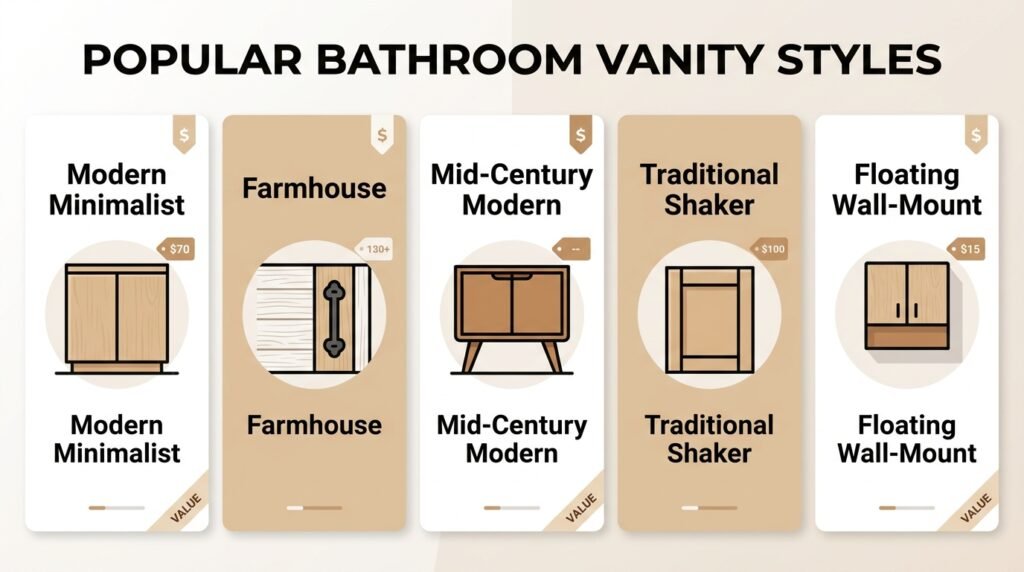
Mid Century Style
Mid century vanities lean on tapered wood legs, warm walnut or teak tones, and slim hardware. The style works well in a small bathroom because the raised legs keep the floor visible, which makes the room feel larger than it is. This makes it a favorite pick for a small bathroom remodel, where every inch of visual space counts.
Budget options typically run 250 to 700 dollars. Check the leg attachment point closely on cheaper models; that joint takes the most stress and is the first place low quality construction shows up.
Farmhouse Style
Farmhouse vanities usually pair a distressed or painted wood finish with an apron-front sink or a chunky, furniture-style base. White, cream, and sage green are the most common finishes.
Prices generally fall between 300 and 800 dollars. Because farmhouse style leans on visible wood texture, a lower-cost model may use a printed wood grain finish instead of real wood veneer. Ask the retailer directly if you can’t tell from photos alone.
Rustic Style
Rustic vanities emphasize raw or lightly finished wood, visible grain, and hardware like iron or aged bronze pulls. Barn wood and reclaimed wood fall under this category too.
You can find rustic vanities from 250 to 700 dollars. This is one of the more budget-friendly categories, since a rougher, less refined finish is part of the intended look rather than a flaw to hide.
Antique Style
Antique style vanities borrow ornate legs, carved details, and aged brass or bronze hardware from furniture pieces from past centuries. A true antique costs thousands, but antique style reproductions bring that same look at a fraction of the price using MDF cores with wood veneer.
Budget reproductions run 300 to 900 dollars. Look closely at the carved detail on the drawer fronts; cheaper reproductions use molded resin details glued on rather than carved wood, which chips more easily over time.
Victorian Style
Victorian vanities share DNA with antique style but push further into ornate turned legs, curved silhouettes, and darker wood tones like mahogany or cherry. Marble or marble look countertops are common pairings.
Expect 350 to 900 dollars for an affordable Victorian style vanity. Because the style relies on curved, detailed woodwork, check customer photos rather than just the product render; renders can smooth over rough edges that show up in the real piece.
Vintage Style
Vintage vanities sit between mid century and antique, usually pulling from 1920s through 1960s design cues: rounded corners, pastel or two tone finishes, and simple round pulls. It’s a softer, friendlier look than strict antique reproductions.
Prices typically land between 250 and 650 dollars. Vintage style is one of the easier looks to find secondhand too, since actual vintage vanities from those decades show up regularly at estate sales and architectural salvage shops for less than a new reproduction.
Craftsman Style
Craftsman vanities draw from the American Arts and Crafts movement: quarter sawn oak grain, exposed joinery details, and hardware in hammered copper or oil rubbed bronze. The look favors visible wood joints as a design feature rather than hiding them.
Budget craftsman vanities run 300 to 750 dollars. The oak grain pattern is the detail to check most closely, since a laminate imitation flattens the grain in a way real quarter sawn oak never does.
Cottage Style
Cottage vanities use soft, painted finishes in white, blue, or pale yellow, often with beadboard paneling on the cabinet front. The overall feel is light, casual, and a little romantic, closer to a beach or lake house than a formal bathroom.
Expect 250 to 650 dollars for an affordable cottage vanity. Beadboard paneling made from real wood holds paint longer than a molded plastic panel that mimics the same grooves, so check the material listing before buying.
Modern Style
Modern vanities strip everything down to flat slab fronts, minimal or hidden hardware, and often a floating wall-mounted design. Finishes tend toward high gloss white, matte black, or warm wood tones with no visible grain pattern.
Modern vanities run a wider range, from 300 to over 1,000 dollars, because floating installation and integrated sinks add cost. A basic freestanding modern vanity stays closer to the lower end of that range. If a floating design is part of a larger overhaul, it usually pairs best with a full bathroom remodel so the plumbing and wall support are handled correctly.
What to Check Before You Buy
Regardless of which bathroom vanity styles you’re comparing, a few details separate a piece that lasts from one that doesn’t.
Check the box construction material first. Solid wood costs more but handles humidity best. Plywood is the strongest budget option, since it resists warping better than particleboard or MDF in a damp bathroom. Avoid raw particleboard entirely for anything near water.
Check the drawer glides next. Soft close, full-extension glides cost only a little more than basic glides but last years longer under daily use.
Measure your space before you shop. A vanity that looks affordable can still be the wrong choice if it doesn’t leave enough floor clearance in front of it. The National Kitchen and Bath Association recommends at least 30 inches of clear floor space in front of a vanity for comfortable use.
Finally, compare warranty terms across bathroom vanity styles before deciding. A one year warranty on cabinetry is common at the budget end. Some mid range brands extend coverage to five years on the box and finish, which matters more in a humid bathroom than in any other room of the house.
If you’d rather have a professional handle sourcing, sizing, and installation from start to finish, book a free estimate and get a fixed written quote for your project.
Frequently Asked Questions
What is the cheapest bathroom vanity style to buy?
Shaker-style vanities are generally the least expensive because their flat-panel doors require the least labor and material to produce, while still looking polished in almost any bathroom.
What bathroom vanity style is timeless?
Shaker and mid-century styles both hold their value and visual appeal over time, since their clean lines don’t tie the room to a specific decorating trend the way heavily ornate styles can.
How much should I budget for an affordable bathroom vanity?
Most affordable single sink vanities across popular styles fall between 250 and 800 dollars, though modern floating designs and antique reproductions can run higher.
Can I mix vanity styles with different bathroom decor?
Yes, as long as the vanity’s material and hardware finish echo something else already in the room, such as matching the cabinet hardware finish or wood tone with existing trim.
Is MDF a bad material for a bathroom vanity?
MDF isn’t inherently bad, but it needs a sealed finish to resist moisture. A well sealed MDF vanity can perform fine for years, while an unsealed one swells quickly near a sink.